
It's no longer just the "it" that can chat: Artificial intelligence has finally grown hands and feet!
For the past few years, we have been interacting with ghosts. A remarkably articulate, creative, and sometimes frustratingly convincing ghost, but a ghost nonetheless. Generative AI has lived entirely in the realm of symbols. It processes text, generates images, and composes code, all within the incorporeal domain of data. It could describe the exact feeling of gripping a cold steel wrench, but it could never reach out and grab one. That fundamental barrier—the moat between the digital and the physical—is what made the conversations of 2023 and 2024 feel, in retrospect, like a long, detailed rehearsal. The real performance, as CES 2026 made abundantly clear, has just begun. We have moved from the era of the disembodied brain to the dawn of the embodied worker.
Walking through the Las Vegas Convention Center in January, the shift in atmosphere was palpable. It wasn't just about faster chips or larger language models. It was about witnessing the emergence of a new species of machine: one that finally has the hardware to match its software. Deutsche Bank analysts at the event framed 2026 as the year we move from "testing/validation to scaling" for autonomous vehicles, and crucially, from "laboratory experiments to small-scale deployment" for humanoid robots . The proof was scattered across the show floor. Boston Dynamics' Atlas, once a mesmerizing demo of choreographed backflips, has been retooled. Now, powered by a deeply integrated Vision-Language-Action (VLA) model developed with Google DeepMind, it navigates the chaotic, unstructured environment of a mock factory floor, adapting to tasks it has never seen before . It is no longer a dancer; it is a trainee.
This transition from scripted motion to semantic understanding is the core of what we now call "Physical AI." For a robot to be useful, it cannot simply repeat a pre-programmed path. It must perceive, reason, and then act. This requires a new type of intelligence, one that Nvidia is aggressively pursuing with its Isaac GR00T platform, aiming to become the "Android of robotics" . The goal is to give robots a "world model"—an intuitive physics engine in their "minds" that allows them to predict the consequences of their actions. When you ask a robot to "pick up that grape," it needs to understand not just what a grape is, but the minimal force required to avoid crushing it. This is an order of magnitude more complex than generating a sonnet.
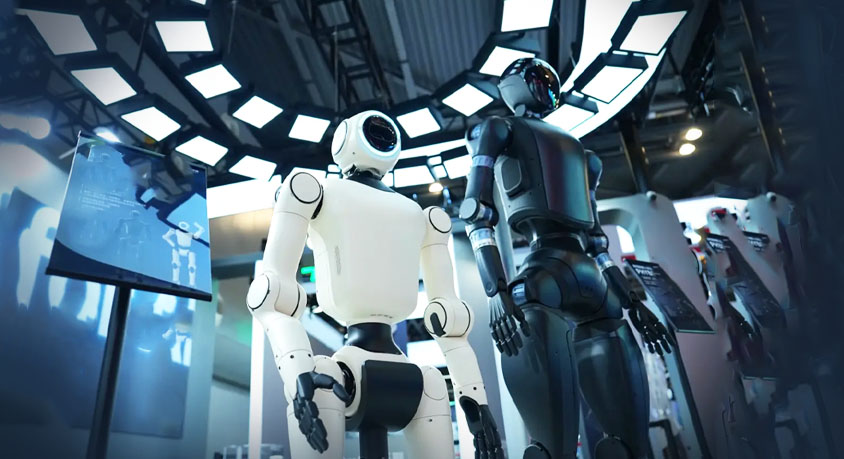
The most compelling evidence of this shift, however, wasn't found in any single robot's performance, but in the anatomy of the industry itself. Look closely, and you'll see the supply chains of the automotive and robotics worlds beginning to fuse. Hyundai Mobis, a titan of auto parts, is now producing actuators for the Atlas robot . Schaeffler, another automotive giant, is positioning itself as the "muscle" provider for the entire robotics industry, offering the kind of integrated, high-torque actuators that were once custom-built for research labs . This is the industrialization of the robot body. When you can leverage the economies of scale from the automotive industry, which produces millions of vehicles a year, the cost of building a humanoid robot plummets. The conversation is no longer about if they can work, but when they will become as cheap and ubiquitous as a forklift.
Deutsche Bank outlined a direct formula: scale equals lower costs. Some firms are projecting costs dropping from $200,000 to $50,000 per unit as production ramps into the thousands . Boston Dynamics and Hyundai have already allocated Atlas's entire 2026 production run to Hyundai's own factories . This is a critical feedback loop. The robots are being deployed not in some distant future, but in the factories of their parents, learning to build the very cars that will fund their next generation. The global Physical AI market is projected to explode from $6.44 billion in 2026 to nearly $83 billion by 2035, a compound annual growth rate of nearly 33% . This growth is fueled by a simple, powerful idea: intelligence that can act is infinitely more valuable than intelligence that can only think.
We are, in a very real sense, teaching the ghost to grip. The implications extend far beyond the factory floor. Samsung has announced a strategy to transition its entire global manufacturing operation into "AI-Driven Factories" by 2030, deploying specialized AI agents for quality control, logistics, and safety . In logistics, Amazon's fleet of over a million robots now handles 75% of its global deliveries, and its "Sequoia" system has improved inventory processing speeds by 75% . The technology is moving from the "proof of concept" stage to what ARC Advisory Group calls "tangible autonomy on the shop floor" .
The critical question is no longer, "Can AI understand the world?" It clearly can. The new, far more consequential question is, "What will it choose to do, now that it finally has a body to act?" The answer to that question will reshape our factories, our logistics, and ultimately, our physical reality. The conversation has left the screen, and it's now happening in the world, one perfectly executed weld at a time.
MORE FROM WIRED

- Jurassic Park Warning? Scientists Just Made an Extinct 'Ghost' Open Its Eyes
- The Next Bet: Making the Blind See, and the Rest of Us Transparent?
- They Decided to Build a Nuclear Reactor in Their Own Backyard to Feed AI
- Apr,10,2026
- Your first household robot is finally coming!
- Apr,08,2026
- Apple's Crease Battle: Can This $2,000 Phone Save a Dull Era?
- Apr,06,2026
- "Eye Contact" in Autonomous Driving—When AI Cars Learn Human Intuition
- Apr,04,2026
- The Deepfake Called Me "Dad." I Almost Sent $50,000.
- Apr,02,2026