
"Eye Contact" in Autonomous Driving—When AI Cars Learn Human Intuition
There is a moment in every pedestrian's life that requires no instruction, only instinct. You stand at the edge of a street, make brief eye contact with an oncoming driver, and receive an almost imperceptible nod that says, "I see you. Go ahead." This exchange, lasting perhaps half a second, contains more social information than any traffic sign could convey. It is a pact sealed in shared humanity. That pact is now being rewritten by machines that do not have eyes to meet, but are learning to watch yours instead.
On January 23, 2026, in Santa Monica, a Waymo autonomous vehicle struck a child who ran into the street from behind a parked SUV near an elementary school. The child was not seriously injured. The vehicle had detected the pedestrian the moment they emerged, braked hard, and reduced its speed from seventeen miles per hour to under six before contact. Waymo's subsequent analysis suggested a fully attentive human driver would have made contact at approximately fourteen miles per hour. The machine did not avoid the collision, but it mitigated it substantially. This is the new reality of streets shared with autonomous vehicles—not a world without incidents, but a world where the calculus of harm is being recalculated by algorithms.
The technology underlying this recalculation is undergoing a fundamental shift. For years, autonomous vehicles operated on a modular architecture: perception identified objects, prediction guessed trajectories, planning charted courses. Each module introduced potential errors. Tesla's approach, increasingly influential, compresses this entire pipeline into a single end-to-end neural network trained on billions of miles of real driving data. The system does not execute programmed rules; it develops something approaching intuition, learning from human drivers how to navigate the unspoken choreography of the road.
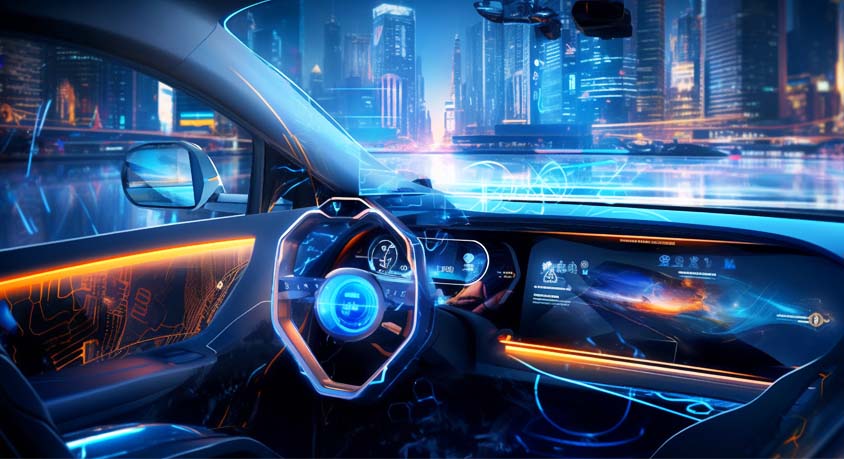
In February 2026, Tesla demonstrated what this intuition looks like in practice. The company's FSD software, updated to version 14.2, now includes the ability to recognize and respond to human gestures. In user-uploaded videos, a Tesla navigates a narrow street while a man outside directs traffic. When he waves the car forward, it edges ahead cautiously. When he signals it to stop, it halts. This is not pattern matching on static objects; it is reading intent from dynamic human behavior, translating the subtle language of the body into machine action.
The technical term for this capability is Physical AI—artificial intelligence that understands not just pixels, but gravity, friction, and the unspoken rules of social navigation. At CES 2026, Nvidia unveiled its latest autonomous driving platform designed to perform multi-step reasoning in complex traffic environments, inferring causal relationships between different road users. Chinese automaker Great Wall demonstrated a model that can deduce from a rolling ball that a child might run into the street, anticipating danger before it materializes. The common thread is prediction: not just recognizing what is there, but forecasting what is about to happen.
This shift changes the fundamental nature of trust between pedestrians and machines. Research from the Institute of Design at Illinois Tech found that fifty-six percent of participants ranked transparent communication of a machine's intent as the most important factor in their willingness to share space with it. When a human driver slows and makes eye contact, intent is communicated implicitly. When an autonomous vehicle approaches, the pedestrian must infer intent from behavior alone. The machine's internal state is opaque, and opacity breeds unease.
The Santa Monica incident illustrates both the progress and the persistence of this unease. The Waymo vehicle performed better than a human would have. Yet the National Highway Traffic Safety Administration opened an investigation, focusing on whether the robotaxi exercised appropriate caution given its proximity to an elementary school. The question was not whether the machine performed well in absolute terms, but whether it performed well enough in human terms—whether it understood the vulnerability of a child. These are not engineering questions. They are moral ones.
There is a deeper asymmetry at work. Humans are predictable in their unpredictability. We jaywalk, we gesture, we change our minds mid-step. Autonomous vehicles are designed to be predictable—to follow rules, to avoid surprises. But predictability alone does not create trust. Trust emerges from mutual understanding, from the sense that the other party sees you as you are and adjusts accordingly. A vehicle that always stops at crosswalks is reliable, but a vehicle that can read your intention to cross mid-block and slow preemptively is something more: it is attentive.
What makes this moment significant is that the machines are no longer waiting to be read. They are learning to read back. When a Tesla interprets a traffic controller's gesture, when a Waymo anticipates a pedestrian's trajectory, the relationship shifts from unidirectional to bidirectional. The car watches you, and you watch the car, and both are engaged in the same ancient dance of mutual assessment. The difference is that one partner is now made of silicon and code, and its way of seeing is fundamentally alien.
The question that follows is not whether these systems will become technically capable of safe navigation. The evidence suggests they already are, in many contexts, safer than human drivers. Waymo has delivered 127 million rider-only miles, and its vehicles are never distracted. The reaction times are measured in milliseconds. The technical trajectory is clear.
The harder question is whether trust can be engineered as deliberately as perception and planning. The Illinois Tech framework suggests it can, through design choices that communicate intent clearly. Sixty-four percent of participants preferred robots that used simple, polite motion cues over those that attempted to convey personality through constant emotiveness. Calm signaling beats performative friendliness. The machine that inspires trust is not the one that pretends to be human, but the one that is transparently, reliably itself.
When you step off the curb in 2026, the vehicle approaching may have no driver behind the wheel. It will have sensors watching from every angle, neural networks parsing your posture and trajectory. It will not nod or gesture. But it will be watching your eyes. The question is whether, over time, that watching will feel like care or surveillance. The technology will continue to improve. The relationship will take longer. And the streets, as always, will tell the truth.
MORE FROM WIRED
- It's no longer just the "it" that can chat: Artificial intelligence has finally grown hands and feet!
- Jurassic Park Warning? Scientists Just Made an Extinct 'Ghost' Open Its Eyes
- The Next Bet: Making the Blind See, and the Rest of Us Transparent?
- Apr,12,2026
- They Decided to Build a Nuclear Reactor in Their Own Backyard to Feed AI
- Apr,10,2026
- Your first household robot is finally coming!
- Apr,08,2026
- Apple's Crease Battle: Can This $2,000 Phone Save a Dull Era?
- Apr,06,2026
- The Deepfake Called Me "Dad." I Almost Sent $50,000.
- Apr,02,2026