
Jurassic Park Warning? Scientists Just Made an Extinct 'Ghost' Open Its Eyes
There is a particular quality to the gaze of an animal that should not exist. It is not menace, but something far more unsettling: familiarity. When the doors of a secure facility opened last year to reveal Romulus and Remus, the first living creatures bearing the genetic signatures of the dire wolf, the world saw two healthy canine pups tumbling over each other. They yawned, they tussled, they regarded their handlers with the same head-tilt curiosity any puppy owner would recognize. And that, precisely, is the source of the cognitive dissonance. These animals, engineered by Colossal Biosciences, are not a resurrection in the literal sense. They are a palimpsest—a modern gray wolf genome overwritten in twenty specific places with ancient DNA extracted from fossils up to 72,000 years old. The result is a living creature that looks and howls like something that vanished from North America ten millennia ago.
To understand what Colossal has actually achieved, one must first discard the cinematic metaphor. This is not Jurassic Park. There is no complete ancient genome waiting to be transplanted. The process is far more intricate. Scientists sequenced two dire wolf fossils, identifying approximately 1.9 million genetic variants that distinguish them from modern gray wolves. From this vast haystack, they selected just twenty edits across fourteen key genes that code for the most distinctive traits: the robust shoulder structure, the larger skull and teeth, the characteristic white coat, and even unique vocalization patterns. These edits were introduced into gray wolf cells, and after a 65-day gestation in a surrogate mixed-breed hound, Romulus and Remus entered the world—creatures whose very existence poses a profound question: if we can build it, should we?
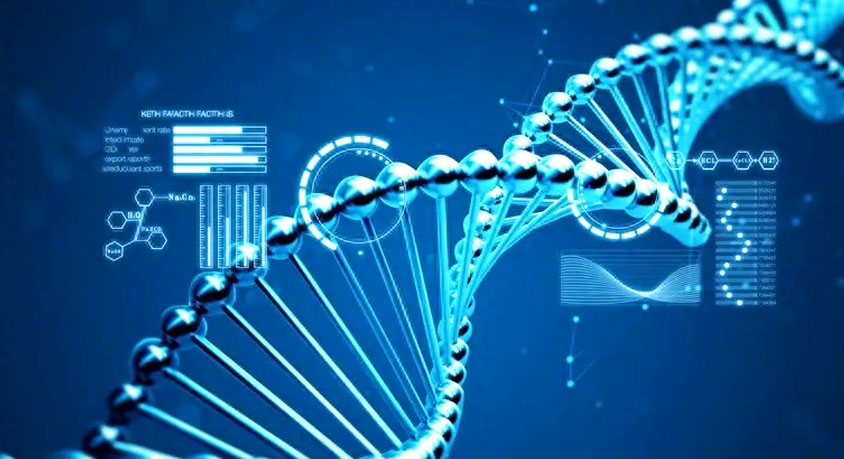
This question becomes even more pointed when we step away from the spectacle of de-extinction and enter the quiet, desperate world of the hospital. In the summer of 2025, a six-month-old child identified only as "Baby KJ" became the recipient of a medical intervention with no precedent. Diagnosed with CPS1 deficiency, a devastating genetic disorder, his body was unable to process ammonia, a toxic byproduct of protein metabolism. Without intervention, the buildup causes irreversible brain damage and death. Instead of a liver transplant, a team at the Children's Hospital of Philadelphia designed a therapy for exactly one patient. They developed a bespoke guide RNA targeting his specific mutation, packaged it in a lipid nanoparticle—the same delivery technology used in mRNA vaccines—and infused it into his bloodstream. The therapy, an in vivo base editor, precisely corrected the single-letter error in his DNA. In approximately six months from diagnosis to treatment, the entire architecture of pharmaceutical development was compressed into a personalized, one-off medical event.
These two stories, unfolding simultaneously in 2025 and 2026, represent the opposite poles of a single technological revolution. At one end, we have the public spectacle of de-extinction, funded by more than $600 million in private capital. At the other, we have the intimate drama of a single child receiving a cure that exists only for him. Yet the underlying machinery is identical. Both rely on our newfound ability to read the genome with extraordinary precision, to edit it with tools that can target individual nucleotides, and to deliver those edits into living cells with increasing reliability. The technology is indifferent to the application; it simply awaits our instruction.
The ethical landscape, however, is anything but indifferent. The ambition is staggering: to restore biodiversity, to reverse the damage humans have wrought, to engineer solutions to climate change by reintroducing mammoths to the Arctic tundra where their grazing might help preserve permafrost. Critics, however, see a different story. They argue that these "de-extinct" animals are at best simulacra—gray wolves dressed in ancient costumes. They warn that the rhetoric of resurrection could undermine conservation efforts, fostering a dangerous complacency that if we can bring them back, we need not work so hard to save them now.
The N=1 model exemplified by Baby KJ raises an equally complex set of questions. If we can design a therapy for one child, why not for the next? The industry term is "scaling out"—creating reproducible workflows that can be deployed rapidly for each new patient, rather than manufacturing millions of doses of a single drug. The FDA worked closely with Baby KJ's team, compressing timelines that normally stretch for years into months. But can this become routine, or will it remain the province of extraordinary efforts? And what of the patients whose mutations are too rare, too complex, or simply too late?
Perhaps the most profound question lies at the intersection of these two trajectories. If we can edit the germline—the sperm and egg cells that pass genetic information to future generations—then the interventions we apply to individuals become legacies. Colossal is explicit that its work is not aimed at human applications, but the tools it develops will inevitably find their way into human medicine. The line between treating disease and enhancing traits is already blurring. The science of "what we can do" is racing ahead of any social consensus on "what we should do."
MORE FROM WIRED
- It's no longer just the "it" that can chat: Artificial intelligence has finally grown hands and feet!
- The Next Bet: Making the Blind See, and the Rest of Us Transparent?

- They Decided to Build a Nuclear Reactor in Their Own Backyard to Feed AI
- Apr,10,2026

- Your first household robot is finally coming!
- Apr,08,2026

- Apple's Crease Battle: Can This $2,000 Phone Save a Dull Era?
- Apr,06,2026

- "Eye Contact" in Autonomous Driving—When AI Cars Learn Human Intuition
- Apr,04,2026
- The Deepfake Called Me "Dad." I Almost Sent $50,000.
- Apr,02,2026