
Your first household robot is finally coming!
For roughly three million years, the relationship between humans and tools followed a simple trajectory: we moved, the tools stayed still. A hammer waited patiently on the workbench until a hand reached for it. A washing machine sat in the basement, its entire existence limited to the precise spot where it was installed. Even the most advanced appliances were essentially statues with motors—capable of action, but only within the narrow radius of their fixed positions. This arrangement made sense when tools were stupid. If they could not perceive their surroundings or adapt to changing conditions, the safest place for them was bolted to the floor. That era is ending not with a bang, but with the soft whir of a machine folding a bath towel.
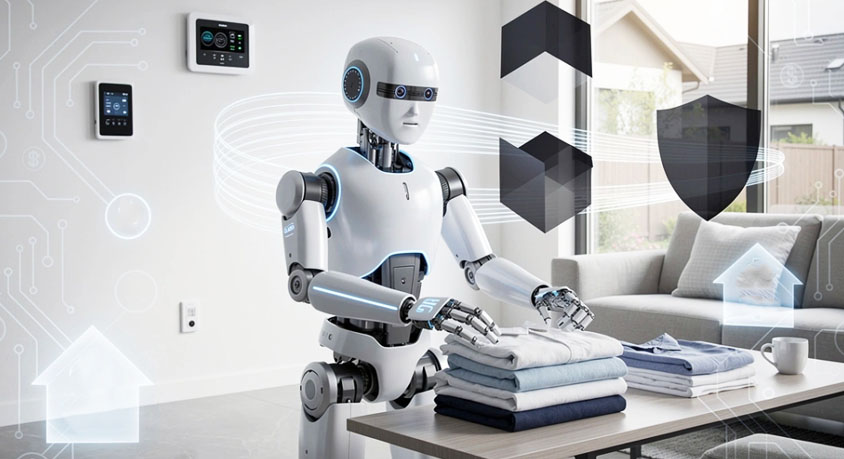
In 2026, for the first time, the tool is coming to us. Two companies, 1X Technologies and Sunday Robotics, are launching home trials of robots designed not for factories or warehouses, but for the unstructured chaos of the American living room. The machines bear names like Neo and Memo, and their job descriptions are deliberately mundane: fold laundry, load the dishwasher, make coffee, tidy up. This is not the stuff of science fiction spectacle. There will be no backflips, no heroic rescues, no displays of superhuman strength. Instead, there will be thousands of small, repetitive movements—grasping a sock, closing a cabinet door, wiping a counter—executed reliably enough that a human can finally stop doing them. The ambition is both modest and staggering: to become invisible by being useful.
The Norwegian-American startup 1X, backed by OpenAI and private equity giant EQT, is perhaps the most visible player in this emerging market. Its robot Neo, a humanoid machine standing roughly five and a half feet tall and weighing just sixty-six pounds, is designed explicitly for household assistance. The company began taking pre-orders in late 2025, offering two pathways to ownership: a $20,000 purchase price or a $499 monthly subscription. More significantly, 1X has partnered with Nvidia to integrate its latest AI models, giving Neo the ability to learn not through explicit programming but through observation. The robot watches humans perform tasks, builds an internal model of how those tasks should look when completed successfully, and then attempts to replicate the outcome. It is less a puppet and more an apprentice.
Sunday Robotics, founded by Stanford roboticists Tony Zhao and Cheng Chi, has taken a different approach to the same problem. Its robot, Memo, deliberately avoids the humanoid form. It rolls on a stable base reminiscent of a oversized robot vacuum, with a articulated torso rising from the platform and a cartoonish face peering out from under a plastic baseball cap. The design choice reflects a practical insight: legs are mechanically complex and offer few advantages for tasks that occur within a single floor of a home. By eliminating the challenge of dynamic balance, Sunday can focus its engineering effort on what matters most—the hands. And those hands have been trained on an unprecedented dataset: ten million real-world household actions captured from more than five hundred homes using specialized "skill capture" gloves. Memo has watched humans load dishwashers, fold shirts, and wipe counters. It has seen the infinite variation in how different people approach the same task. Now it must prove it can generalize from that data to the unique configuration of your kitchen.
The timing of these launches is not coincidental. America is aging, and the ratio of available caregivers to those needing care is deteriorating. Two-income households are the norm, leaving little time for the domestic labor that previous generations treated as a full-time responsibility. There is genuine demand for a machine that can reliably perform the dull, repetitive work of maintaining a home. But there is also skepticism, rooted in decades of broken promises. The robotics industry has been claiming that household help is just around the corner since the 1980s. What changed?
The answer lies in the convergence of three technologies. First, the cost and capability of sensors have reached a point where a robot can perceive its environment in real time with sufficient accuracy to avoid stepping on a pet or crushing a glass. Second, batteries have improved enough to provide meaningful operational windows—Neo runs for approximately four hours on a charge, enough to complete a substantial set of tasks before returning to its dock. Third, and most importantly, artificial intelligence has progressed from pattern matching to something approaching world modeling. 1X recently demonstrated a system where Neo generates an internal video of a successful task completion before attempting it physically, imagining the outcome and then reverse-engineering the motions required to achieve it. This is not rote memorization. It is the beginning of flexible intelligence.
Yet the most honest assessments of where this technology stands come from the companies themselves. 1X's early demonstrations sparked controversy when eagle-eyed viewers noticed that some seemingly autonomous actions were actually teleoperated by humans wearing VR headsets. The company explained that operators were present only during specific filming sessions and that the robot performs tasks autonomously in normal use, but the incident revealed the gap between demo-ready and production-ready. Sunday is even more circumspect: its "founding family" program will place robots in just fifty homes by late 2026, a pilot project designed to gather data rather than generate revenue. The message is clear. These machines are learning. They will make mistakes. They will need patience.
The deeper question, and the one that will determine whether this wave of household robotics succeeds or joins previous waves in the graveyard of overpromised technologies, is about trust. A factory robot operates in a controlled environment where humans are excluded for safety. A home robot operates where children play, where elderly relatives move slowly, where pets behave unpredictably. The margin for error is zero. A dropped glass is an inconvenience. A collision with a grandparent is a catastrophe. The companies building these machines understand this, which is why they speak in terms of months and years rather than weeks, why they emphasize safety certifications and soft materials, why they release robots to hundreds of homes rather than millions.
There is also a more subtle question about what we lose when we outsource the mundane. Folding laundry is tedious, but it is also a form of presence—a small, repetitive act that connects us to the physical reality of our households and the people who inhabit them. Loading a dishwasher is mindless, but it is also a moment of low-stakes competence, a task completed successfully with no audience and no applause. To hand these activities to a machine is to reclaim time, certainly, but it is also to surrender a particular kind of intimacy with our own lives. The trade may be worth it. For a single parent working two jobs, for an aging adult determined to remain in their home, for anyone whose hours are consumed by the endless cycle of cleaning and tidying, a robot that reliably folds a shirt is not a luxury. It is liberation.
MORE FROM WIRED
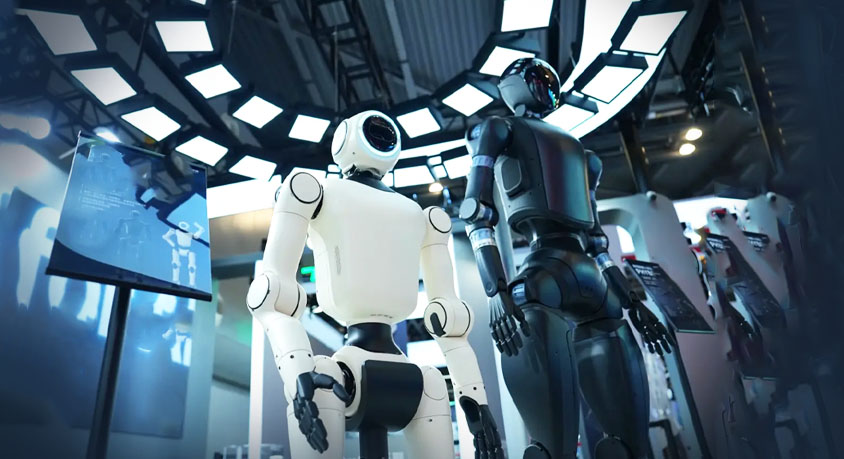
- It's no longer just the "it" that can chat: Artificial intelligence has finally grown hands and feet!

- Jurassic Park Warning? Scientists Just Made an Extinct 'Ghost' Open Its Eyes
- The Next Bet: Making the Blind See, and the Rest of Us Transparent?
- Apr,12,2026
- They Decided to Build a Nuclear Reactor in Their Own Backyard to Feed AI
- Apr,10,2026

- Apple's Crease Battle: Can This $2,000 Phone Save a Dull Era?
- Apr,06,2026
- "Eye Contact" in Autonomous Driving—When AI Cars Learn Human Intuition
- Apr,04,2026
- The Deepfake Called Me "Dad." I Almost Sent $50,000.
- Apr,02,2026