
What would happen if probes from four countries simultaneously headed for the moon?
There is a strange irony in looking up at the night sky, at that familiar pale disk that has hung there unchanged for all of human history, and realizing it now has a traffic problem. The Moon has always been a symbol of solitude—the single companion of a lonely planet, silent, static, utterly still. But stillness is a luxury of empty places, and the Moon is no longer empty. By the end of 2026, if schedules hold, four separate missions from at least as many nations will be en route to its surface, their trajectories crossing the same volume of cislunar space, their landing sites clustering around the same few square kilometers of valuable real estate. The question is no longer whether we can reach the Moon. It is whether we can learn to share it.
The immediate cause of this congestion is a convergence of timing and technology. NASA's Artemis 2 mission, delayed multiple times by hydrogen leaks and helium flow issues, is now targeting an April 2026 launch window for its crewed lunar flyby, the first human journey near the Moon since 1972. China's Chang'e-7, a sophisticated robotic mission carrying 18 science payloads from seven countries, is scheduled for launch in the second half of the year, aiming for a precision landing within 100 meters of a target on the rim of Shackleton crater. Firefly Aerospace, under contract to NASA, will deliver ESA's Lunar Pathfinder communications satellite to lunar orbit, laying the groundwork for future navigation infrastructure. Astrobotic's Griffin-1 mission, delayed to July 2026, will carry commercial rovers and payloads to the surface as part of NASA's CLPS program. This is not a race in the traditional sense—nations are not sprinting to plant flags. It is something more complex and potentially more fraught: a simultaneous arrival, like multiple families showing up to the same empty lot with blueprints for different houses.
The convergence is not coincidental. It reflects a shared recognition that the lunar south pole is the most valuable piece of real estate in the inner solar system. Unlike the equatorial regions visited by Apollo, the poles offer something rare on an airless world: continuous sunlight for power generation, and permanently shadowed craters that may harbor water ice. Water is the currency of space exploration—not just for drinking, but for splitting into hydrogen and oxygen to make rocket fuel. A reliable source of water on the Moon means a refueling station, a waypoint for deeper space journeys, a potential economy. Chang'e-7 carries a hopping spacecraft designed specifically to descend into these dark craters, touch the surface, and analyze the soil for volatiles. If it succeeds, it will achieve what no mission has done before: direct detection of usable water on another world.
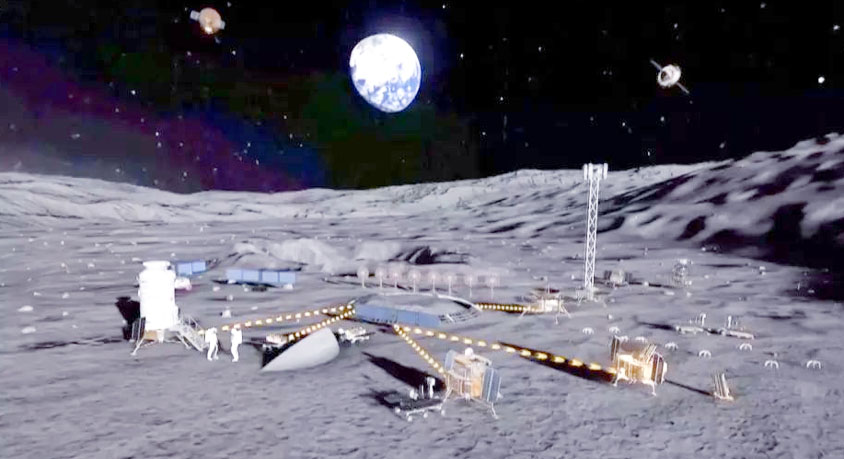
But scientific coordination does not always imply political alignment. While NASA and ESA collaborate on Lunar Pathfinder, and while international payloads ride on Chang'e-7, the broader context is competitive. China has announced plans to send astronauts to the Moon by 2030 and is building toward an International Lunar Research Station with Russian and other partners. The United States, through the Artemis Accords, is assembling a separate coalition of nations with its own principles for lunar behavior. The two frameworks overlap in some technical areas but diverge on fundamental questions of property rights, resource extraction, and military activity. The missions launching in 2026 are scientific, but they are also precursors. They map the terrain, assess the resources, and establish the precedents that will shape everything that follows.
The commercial dimension adds another layer of complexity. SpaceX, already contracted for Artemis landings, has shifted its rhetoric from Mars to the Moon, with Elon Musk now discussing a "Moonbase Alpha" and a satellite-slinging launch device on the lunar surface. Blue Origin, having lost the first lander competition to SpaceX, secured a $3.4 billion contract for Artemis 5 and is pushing its Blue Moon lander through testing. These are not abstract ambitions. They are near-term programs with hardware in development and launch dates on calendars. The same companies that revolutionized low-Earth orbit with commercial cargo and crew are now preparing to do the same for the lunar surface, bringing with them the same competitive instincts and intellectual property concerns that define terrestrial business.
The practical implications of this crowding are only beginning to be understood. Cislunar space—the volume between Earth and Moon—has no air traffic control, no right-of-way rules, no collision avoidance protocols beyond what individual operators coordinate voluntarily. The Lunar Pathfinder mission is designed to provide communications relay, but its presence also adds to the congestion. The landing sites around Shackleton crater are scientifically optimal but geographically cramped. When multiple nations want to put hardware in the same few square kilometers, the potential for interference, whether accidental or intentional, rises.
There is also a subtler question about what happens when exploration becomes habitation. The Apollo missions stayed for days. The Artemis missions aim to stay longer. The Chinese research station aims to stay permanently. A transient visitor leaves little trace and creates few conflicts. A permanent resident must negotiate boundaries, coordinate activities, and resolve disputes. The legal framework for such coordination barely exists. The Outer Space Treaty of 1967, the foundational document of space law, forbids national appropriation but says nothing about commercial claims or scientific priority. It was written for a world where reaching the Moon was itself an achievement, not a prelude to staying there.
MORE FROM WIRED
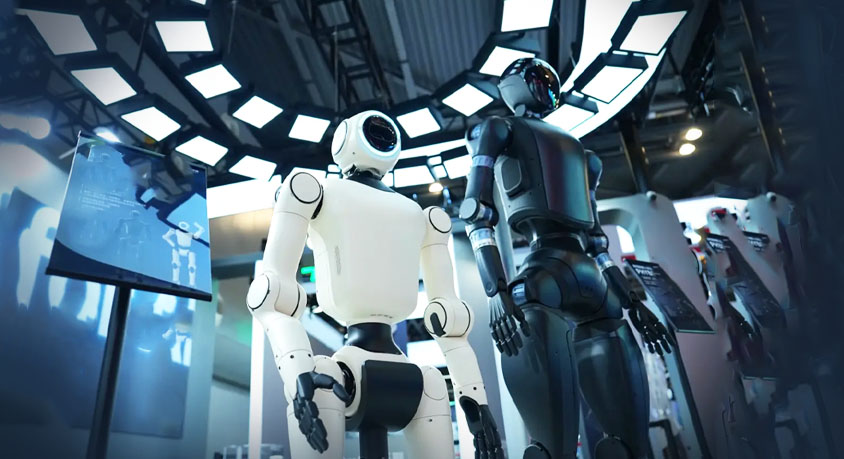
- It's no longer just the "it" that can chat: Artificial intelligence has finally grown hands and feet!

- Jurassic Park Warning? Scientists Just Made an Extinct 'Ghost' Open Its Eyes

- The Next Bet: Making the Blind See, and the Rest of Us Transparent?
- Apr,12,2026

- They Decided to Build a Nuclear Reactor in Their Own Backyard to Feed AI
- Apr,10,2026

- Your first household robot is finally coming!
- Apr,08,2026

- Apple's Crease Battle: Can This $2,000 Phone Save a Dull Era?
- Apr,06,2026

- "Eye Contact" in Autonomous Driving—When AI Cars Learn Human Intuition
- Apr,04,2026